


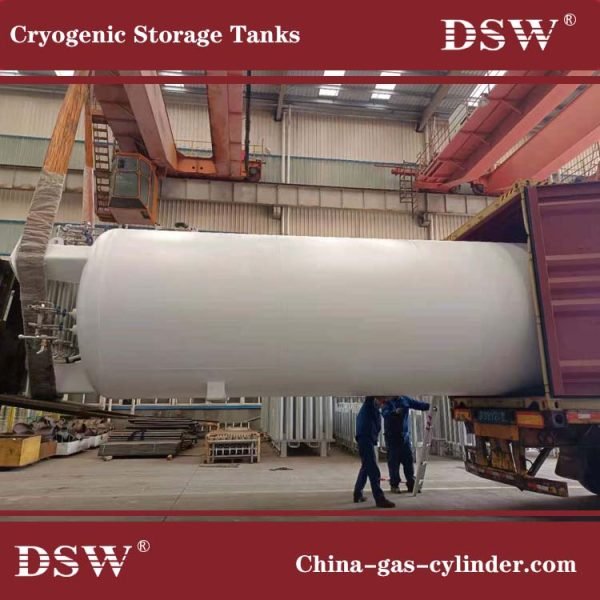

The Self-Pressurization Process of Cryogenic Storage Tanks
The self-pressurization process is crucial for maintaining or increasing the internal pressure of cryogenic storage tanks, which helps keep cryogenic liquids like liquid nitrogen (LN2), liquid oxygen (LOX), and liquid argon (LAR) in liquid form at very low temperatures (typically below -150°C). This process is essential for stabilizing the storage conditions of cryogenic liquids and ensuring their safe and efficient storage and transport. Generally, cryogenic storage tanks have a self-pressurization system, a closed-loop mechanism that includes the storage tank, a booster, and a regulating valve. This system ensures that the pressure inside the tank is effectively controlled, providing a continuous and reliable supply of gas while maintaining optimal conditions for cryogenic liquids.
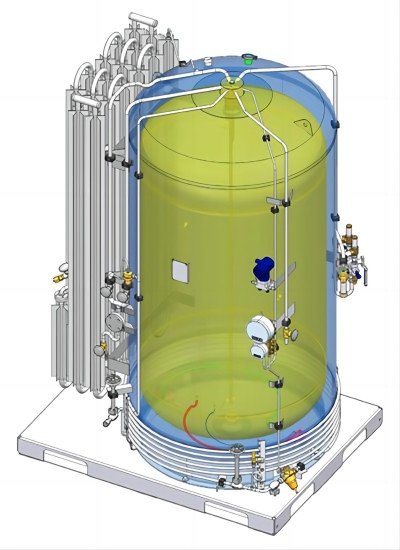
Pressurization System Components
- Vaporization of Cryogenic Liquid
- Cryogenic liquids, stored at extremely low temperatures, naturally vaporize over time due to heat absorption from the surrounding environment. Despite the tank’s insulation, some liquid will inevitably vaporize, forming what is known as boil-off gas.
- This vaporized gas accumulates in the vapor space at the top of the tank.
- Pressurization
- A self-pressurizing system utilizes the boil-off gas to either maintain or increase the pressure within the tank. As gas accumulates in the vapor space, the pressure naturally rises, ensuring that the cryogenic liquid remains pressurized and in liquid form, thus preventing it from reverting to a gaseous state.
- Regulated Pressure
- Pressure relief valves (PRVs), or pressure buildup regulators, are typically equipped with cryogenic storage tank to control internal pressure. By venting excess gas and preventing over-pressurization, these devices ensure that the tank operates within safe limits.
- We carefully regulate the pressure to balance the accumulation of boil-off gas, maintaining the cryogenic liquid in its required low-temperature state.
- Tank Design
- Engineers specifically design self-pressurizing tanks to withstand the internal pressure generated by the accumulating boil-off gas. The tanks’ insulation is essential for reducing the vaporization rate, thereby limiting the need for frequent pressurization cycles and enhancing system efficiency.
- Safety Features
- Pressure relief valves and venting systems equip cryogenic tanks to safely release gas if the internal pressure surpasses the preset safety limits. These safety mechanisms are crucial for preventing over-pressurization, accidents, or damage to the tank.
Applications
The self-pressurization process is particularly beneficial for mobile cryogenic storage systems, such as those used for transporting cryogenic liquids, and for small-scale storage applications where external pressure sources may not be feasible or economical.
It is also used in factories and hospitals, where having cryogenic gases on hand is vital and external pressurization equipment may not be feasible.
Benefits of Self-Pressurization
Operational Efficiency: Self-pressurizing systems eliminate the need for an external gas supply, reducing operational complexity and costs.
Cost-Effectiveness: The system significantly decreases operational expenditures by eliminating the requirement for additional equipment such as compressors or pumps.
Safety: The system’s self-regulating nature and integrated safety mechanisms ensure that the pressure levels remain within safe operating ranges.
Convenience: This feature is ideal for cryogenic storage applications in remote or hard-to-service locations, where external pressurization sources are unavailable.
Examples & Case Studies
A self-pressurised vaporiser facilitates the self-pressurisation process in an LNG storage tank. The vaporizer utilizes heat from the surrounding atmosphere to assist in the vaporization of LNG.

The resulting gas flows through a pipeline, passing through the boil-off gas (BOG) root valve and into the upper gas-phase space of the tank, thereby increasing the internal pressure. As LNG continues to flow into the tank, the liquid level decreases, and the gas-phase space expands. This continuous vaporization process, supported by the self-pressurized vaporizer, elevates the pressure in the tank, ensuring that the levels remain within the necessary parameters. For optimal operation, the system consists of a closed-loop circuit composed of a storage tank, a booster, and a regulating valve. During operation, the self-pressurized gas valve and the liquid-phase valve remain open to allow LNG to flow into the vaporizer, maintaining the required pressure for continued storage and distribution.
In the vaporizer, the atmospheric environment is used as the heat source, and the heat exchange with the air is NG, and the NG passes through the gas phase pipeline. It flows through the BOG root valve of the storage tank and enters the upper gas phase space in the tank, which increases the pressure of the gas phase, thereby increasing the pressure of the LNG cryogenic tank. With the continuous flow of LNG, the liquid level in the tank continues to drop, and the gas phase space continues to increase. In this way, the self-pressurized vaporizer is used to continuously plan LNG to increase the pressure in the tank, so that the pressure of the LNG storage tank continues to rise to achieve Required pressure.
In order to ensure the normal supply of gas, the self-pressurization of the LNG cryogenic tank is completed by a loop composed of a storage tank, a booster, and a booster regulating valve. During operation, the self-pressurized gas valve and liquid phase valve of the storage tank are set to open state, and LNG enters the self-pressurized vaporizer.
The Final
The self-pressurization process is a crucial mechanism that ensures the stability and safety of cryogenic liquids during storage and transport. By using the gas that naturally forms when cryogenic liquids boil, this process keeps the liquids in their liquid form, improving storage conditions, reducing costs, and making the system more reliable. The ability to control pressure without needing outside sources makes this system especially useful for many uses, such as portable cryogenic tanks and small storage systems used in industries, healthcare, and transportation.



No comment