


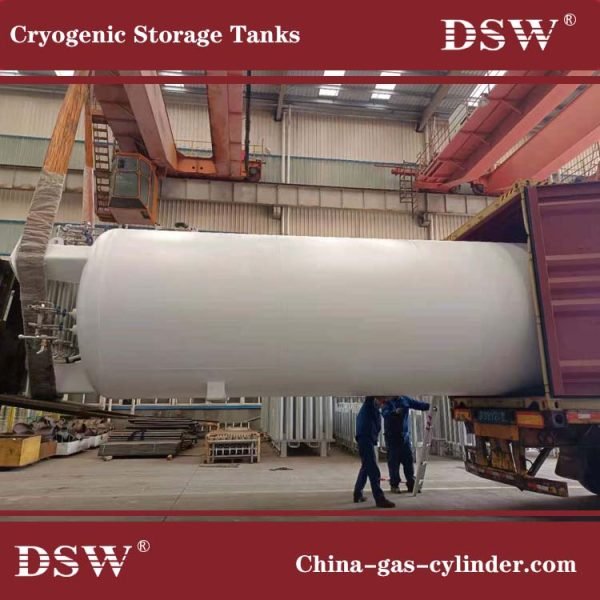
For industrial buyers, selecting a nitrogen supply method is not simply a choice between gas and liquid. It directly influences storage efficiency, supply reliability, safety requirements, infrastructure investment, and long-term operating costs.
This page serves as a technical reference for buyers, engineers, and procurement teams evaluating compressed nitrogen, liquid nitrogen, and air nitrogen supply options for industrial and commercial applications.
This technical reference is provided by DSW Industrial Gas Systems, a supplier of nitrogen cylinders, cryogenic tanks, and on-site nitrogen solutions for industrial users worldwide.
Understanding Nitrogen Supply Forms from a Buyer’s Perspective
All nitrogen used in industry is chemically identical (N₂). What differentiates each supply option is not the gas itself, but how it is stored, delivered, and used.
From a buyer’s perspective, the most important factors include:
- Physical state (gas or liquid)
- Volume density and storage efficiency
- Delivery and supply method
- System and infrastructure requirements
Although the chemical composition remains the same, the physical form of nitrogen—air-generated nitrogen, compressed nitrogen gas, or liquid nitrogen—has a significant impact on storage volume, handling practices, and overall system efficiency.
The following sections explain how nitrogen volume and density differ across these supply forms and how Air Nitrogen fits into the overall comparison, helping buyers select the most appropriate solution for their operational needs.
Air Nitrogen (On-Site Nitrogen Generation)
Air Nitrogen refers to nitrogen gas produced directly from ambient air using on-site or centralized air separation systems. Common technologies include PSA (Pressure Swing Adsorption), membrane separation, and cryogenic air separation units (ASU).
Key Characteristics of Air Nitrogen
- Source: Atmospheric air (approximately 78% nitrogen)
- Supply state: Gas at ambient temperature
- Typical purity range:
- Membrane systems: 95%–99.5%
- PSA systems: 95%–99.999%
- Cryogenic ASU: ≥99.9999%
- Supply method: Continuous, on-demand generation
Air nitrogen is typically selected for stable, long-term gas consumption where cryogenic temperatures are not required and where users want to minimize dependence on cylinder delivery or liquid nitrogen logistics.
Liquid Nitrogen Volume and Expansion Ratio
Liquid nitrogen (LN₂) is nitrogen cooled to −196°C (−321°F), allowing a very large quantity of nitrogen to be stored in a relatively small physical volume.
Liquid-to-Gas Expansion
- 1 liter of liquid nitrogen
- Vaporizes into approximately 694 liters of nitrogen gas
- Measured at standard temperature and pressure
This extremely high expansion ratio makes liquid nitrogen the most volume-efficient way to store and transport nitrogen.
Why Liquid Nitrogen Is So Efficient
- Very high nitrogen density per unit volume
- Minimal storage footprint for large gas demand
- Ideal for bulk supply and continuous high-flow applications
For example, a 10,000-liter liquid nitrogen storage tank can supply nearly 6.9 million liters (approximately 6,900 Nm³) of gaseous nitrogen after vaporization.

Compressed Nitrogen Gas: Volume Reduction by Pressure
Compressed nitrogen is stored as gas at high pressure, typically between 150 and 300 bar, inside steel or composite cylinders.
Typical Cylinder Example
- Cylinder water volume: 40 liters
- Charging pressure: 200 bar
- Equivalent gas volume at ambient conditions:
- Approximately 8,000 liters (8 Nm³) of nitrogen gas
While compression significantly reduces storage volume compared to free gas, it is far less efficient than cryogenic liquefaction.
Practical Characteristics
- Moderate nitrogen density
- Simple handling and infrastructure
- Best suited for low to medium gas consumption
Air Nitrogen and “Effective Volume”
Unlike liquid nitrogen or compressed gas, air nitrogen is supplied directly as gas and does not involve phase change or expansion ratios.
- Output is measured in normal cubic meters per hour (Nm³/h)
- Storage volume is minimal or optional (buffer tanks only)
- Production volume equals actual consumption volume
Example:
A 50 Nm³/h PSA nitrogen generator, operating continuously for 24 hours, produces 1,200 Nm³ of nitrogen gas per day.
Volume and Storage Efficiency Comparison
| Parameter | Air Nitrogen | Compressed Nitrogen | Liquid Nitrogen |
|---|---|---|---|
| Supply form | Gas | Gas | Liquid (vaporized for use) |
| Storage density | Low | Medium | Very high |
| Expansion ratio | None | None | ~1:694 |
| Storage method | Generator + buffer tank | High-pressure cylinders | Vacuum-insulated cryogenic tanks |
| Best suited for | Continuous, stable demand | Small to medium demand | Large-scale, high-volume demand |
| Cryogenic cooling capability | No | No | Yes |
Choosing the Right Nitrogen Supply Based on Volume Needs
Choose Air Nitrogen When:
- Gas demand is continuous and predictable
- Cryogenic temperatures are not required
- Long-term operating cost reduction is a priority
Choose Compressed Nitrogen When:
- Consumption is low or intermittent
- Installation space or capital investment is limited
- Mobility and flexibility are important
Choose Liquid Nitrogen When:
- Gas consumption is high or peak-driven
- Maximum storage efficiency is required
- Cryogenic cooling or freezing is part of the process
Final Summary
From a volume and storage efficiency perspective:
- Liquid nitrogen provides the highest nitrogen content per unit volume and is ideal for bulk and cryogenic applications.
- Compressed nitrogen offers simplicity and flexibility for smaller-scale operations.
- Air nitrogen delivers stable, on-site gas supply with predictable output and reduced logistics dependence.
Selecting the correct nitrogen form is ultimately a balance between required volume, storage efficiency, temperature needs, infrastructure, and long-term cost structure.
TECHNICAL QUESTIONS
Frequently asked questions About Compressed vs. Liquid Nitrogen
Compressed nitrogen is stored as high-pressure gas, while liquid nitrogen is stored at cryogenic temperature and vaporizes into gas. Liquid nitrogen provides much higher storage efficiency for large-volume users.
One liter of liquid nitrogen expands into approximately 694 liters of nitrogen gas at standard temperature and pressure.
Air nitrogen is preferred when gas demand is continuous and predictable, cryogenic temperatures are not required, and long-term operating cost control is a priority.
Compressed nitrogen is typically used for low to medium consumption, backup supply, or intermittent demand rather than continuous large-scale operations.
Key factors include required volume, storage efficiency, infrastructure investment, safety requirements, and total cost of ownership.


No comment