


Liquid nitrogen cryogenic storage systems are essential for industries that require stable, ultra-low temperature environments for preservation, processing, and transport. These systems are widely used in medical research, food processing, industrial manufacturing, and scientific applications where precise temperature control is critical.
Understanding how cryogenic storage works, including tank design, insulation principles, system types, and safety requirements, is key to ensuring operational efficiency and safe handling of liquid nitrogen (LN2).
What Is Liquid Nitrogen?
Liquid nitrogen (LN2) is nitrogen in its liquid state, produced by cooling nitrogen gas to its boiling point of -196°C (-321°F). It is colourless, odourless, non-flammable, and non-toxic, making it one of the most widely used cryogenic fluids across industrial and scientific applications.
Because of its extremely low temperature, liquid nitrogen is highly effective for rapid cooling, freezing, and preservation. It is commonly used for biological sample storage, food flash freezing, metal treatment, electronics manufacturing, and medical cryotherapy.
Its ability to maintain stable cryogenic temperatures makes it an essential medium for applications where temperature control is critical.
What Makes Liquid Nitrogen Storage Technically Challenging
Liquid nitrogen becomes a liquid only at –196 °C (–321 °F) under atmospheric pressure. At this temperature, even minimal heat transfer results in rapid vaporization with significant volume expansion — approximately 1 liter of LN₂ expands to ~694 liters of gas. This introduces challenges unique to cryogenic fluids
- Continuous boil-off even in well-insulated systems
- Pressure accumulation in closed vessels
- Material brittleness at cryogenic temperatures
- Oxygen displacement hazards in enclosed spaces
- Strict requirements for insulation and pressure protection
Because of these factors, LN₂ storage is not a commodity installation — it demands certified cryogenic pressure vessels and rigorously tested systems.
What Is a Cryogenic Liquid Nitrogen Tank?
A cryogenic liquid nitrogen tank is a specially engineered insulated pressure vessel designed to safely store and transport liquid nitrogen at extremely low temperatures. Unlike standard gas cylinders, cryogenic tanks are built to minimise heat transfer and reduce evaporation loss, allowing the liquid to remain stable for extended periods.
These tanks are commonly used in laboratories, hospitals, manufacturing plants, gas supply systems, and bulk storage facilities where continuous access to liquid nitrogen is required.
Construction of Cryogenic Storage Tanks
The performance of cryogenic storage systems depends on advanced structural design and material selection.
Double-Wall Structure
Cryogenic tanks typically consist of an inner vessel for liquid nitrogen storage and an outer shell for protection. The space between them forms a thermal insulation barrier.
Vacuum Insulation System
The interstitial space is evacuated to create a high vacuum, which significantly reduces heat transfer through conduction and convection. This allows liquid nitrogen to remain stable for longer periods.
Material Selection
Stainless steel is widely used due to its excellent low-temperature performance, corrosion resistance, and mechanical strength, ensuring long-term reliability in cryogenic environments.
Safety Components
- Pressure relief valves
- Level gauges and monitoring systems
- Vacuum measurement ports
- Flow and pressure regulators
- Alarm systems (for advanced storage units)
Types of Liquid Nitrogen Storage Systems
Liquid nitrogen storage systems are engineered in different configurations depending on capacity, mobility, and application requirements. The table below summarises the main system types and their industrial use cases.
| Type | Description | Key Features | Typical Applications |
|---|---|---|---|
| Dewar Flasks | Small-capacity cryogenic containers used for handling and short-term storage. | High vacuum insulation, low evaporation loss, portable | Laboratories, sample handling, research use |
| Portable Cryogenic Tanks | Mobile storage units designed for field operations and transport flexibility. | Compact design, safe transport, controlled dispensing | Medical, research, field applications |
| Bulk Storage Tanks | Large stationary systems for high-volume liquid nitrogen storage. | Continuous supply, high capacity, integrated vaporisers | Industrial plants, manufacturing, gas distribution |
| Biological Storage Systems | Specialised systems for long-term preservation of biological materials. | Racks, inventory systems, ultra-low stability | Biobanks, IVF centres, medical research |
| Microbulk Cryogenic Systems | Intermediate on-site storage system between cylinders and bulk tanks. | Automatic supply, reduced handling, efficient delivery | Hospitals, labs, medium-scale industry |
| Integrated Supply Systems | Complete system combining storage, vaporisation, and distribution. | Continuous flow, automation, stable pressure control | Industrial production lines, automated processes |
| Phase Separation Systems | Advanced systems that separate gas-phase nitrogen from liquid supply. | High purity delivery, reduced liquid carryover | Semiconductor, precision manufacturing |
Engineered LN₂ Storage Solutions
Liquid nitrogen storage can take many forms, each tailored to specific operational environments and usage demands.
1. Cryogenic Dewars for Portable & Laboratory Use
For small- to medium-scale storage and mobile operations, cryogenic nitrogen dewars are ideal. These vessels combine vacuum insulation with robust materials to provide safe, long-term, and portable LN₂ storage.
Key Features
- Double-walled vacuum insulation
- Available in multiple capacities for labs, clinics, and research centers
- Designed for minimal heat transfer and high holding times
Ideal for biological sample preservation, cryotherapy support, and laboratory research workflows.
Example of cryogenic dewar for liquid nitrogen storage

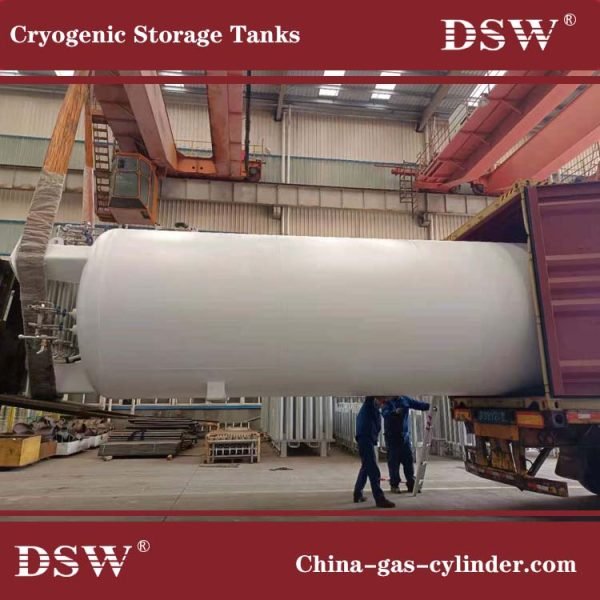
2. LN₂ Cryogenic Storage Tanks for Bulk & Industrial Use
For large-scale on-site storage — whether industrial facilities, medical centers, or manufacturing plants — cryogenic Nitrogen storage tanks provide a rugged stationary solution.
These tanks are engineered to
- Maintain extremely low temperatures over long periods
- Minimize evaporation loss under static conditions
- Support capacities from small bulk tanks to large plant-level systems
Such tanks are appropriate for processes requiring sustained LN₂ supply with minimal refill frequency.
3. Cryogenic Storage Tanks (General Series)
For broader cryogenic storage applications — including liquid nitrogen, oxygen, argon, and other gases — high-capacity cryogenic tanks are essential infrastructure.
These systems are constructed with
- Double-layer vacuum insulation
- High-strength stainless steel and alloy components
- Tailored designs for heavy-duty industrial environments
How Does an LN2 Cryogenic Tank Work?
A cryogenic tank works by maintaining liquid nitrogen at ultra-low temperatures inside a highly insulated environment while controlling internal pressure for safe storage and transfer.
Liquid nitrogen enters the inner vessel through dedicated filling lines. The vacuum-insulated structure slows heat transfer from the surrounding environment, helping reduce evaporation. Since some natural boil-off occurs over time, the tank uses pressure management systems to control internal pressure and maintain safe operating conditions.
Pressure relief valves prevent overpressure, while regulators ensure stable delivery when nitrogen is transferred for use. This design allows cryogenic tanks to provide efficient long-term storage with minimal product loss.
Safety First Protocols and Best Practices
Liquid nitrogen is non-toxic, but handling it incorrectly can lead to severe injury or fatal incidents. Cryogenic hazards include
- Asphyxiation due to oxygen displacement
- Cold burns or frostbite
- Pressure explosion if stored in inappropriate containers
To mitigate these risks, follow these best practices
- Conduct operations in well-ventilated areas
- Use cryogenic PPE (thermal gloves, face shield, insulated eye protection)
- Ensure all relief valves and vacuum seals are inspected regularly
- Use containers only rated for cryogenic liquid service
In enclosed spaces or high-volume systems, oxygen deficiency monitors (ODM) are strongly recommended and often required by code.
Industrial and Scientific Applications
Liquid nitrogen storage systems support a broad range of high-precision applications
Biotechnology & Healthcare
- Cryopreservation of cells, tissues, and reproductive samples
- Vaccine and medical specimen storage
Research and Education
- Laboratory cooling
- Material science experiments
Industrial Engineering
- Metal heat-treating and shrink-fitting
- Semiconductor cooling and thermal management
Each application domain places unique demands on storage solution specifications and operational controls.
Choosing the Right LN₂ Storage Solution
Decisions should be based on
- Required capacity and withdrawal rate
- Frequency of use and refill cycles
- Static holding time and acceptable boil-off losses
- Instrumentation and automation requirements
Advanced systems may incorporate remote telemetry for real-time level, pressure, and temperature monitoring, greatly enhancing reliability and reducing manual oversight.

Compliance and Operational Checklist
A fully compliant cryogenic storage system should include
- Certification to relevant pressure vessel and cryogenic standards (ASME, PED, EN, ISO)
- Verified insulation performance and tested vacuum integrity
- Redundant pressure relief and safety devices
- Documented inspection and maintenance procedures
Always verify regional and local regulatory requirements before procurement and installation.
Emerging Trends in LN₂ Storage Technology
The cryogenic storage industry is advancing rapidly
- IoT-enabled tank monitoring and alerts
- Predictive maintenance based on historical performance data
- Cloud-based reporting and remote supervision
- Enhanced insulation materials that reduce total cost of ownership
These innovations drive higher safety, lower costs, and improved uptime, particularly in demanding industrial and medical environments.
Final Thoughts Your Partner in Cryogenic Storage
Liquid nitrogen storage is not a simple purchase — it is an engineering investment in safety, compliance, and long-term reliability. Choosing certified, purpose-built systems and working with experienced suppliers ensures your facility performs consistently under the most demanding conditions.
Explore our full range of LIQUID NITROGEN storage solutions today, including
- Cryogenic Dewars for laboratory and medical use
- LN₂ Storage Tanks for bulk and industrial applications
- Cryogenic Storage Tanks engineered to international standards
Each solution is backed by professional design, quality manufacturing, and global support.
TECHNICAL QUESTIONS
Frequently asked questions
Liquid nitrogen (LN₂) is used for ultra-low temperature cooling, freezing, and preservation in healthcare, biotechnology, industrial manufacturing, and scientific research. It is commonly used for cryogenic storage of biological samples, food flash freezing, metal treatment, electronics cooling, and medical cryotherapy.
The primary LN₂ storage systems include:
- Cryogenic Dewars – portable, vacuum-insulated containers for laboratories and mobile use. Explore Dewars
- Cryogenic Storage Tanks – larger on-site tanks for industrial or medical applications. Explore Tanks
- General Series Cryogenic Tanks—high-capacity vessels for multiple gases including nitrogen, oxygen, and argon. Explore General Tanks
- Continuous boil-off even in insulated systems
- Pressure accumulation in closed vessels
- Material brittleness at cryogenic temperatures
- Oxygen displacement hazards in enclosed spaces
- High-precision insulation and certified pressure systems required
- Work in well-ventilated areas
- Use cryogenic PPE: thermal gloves, face shield, insulated eye protection
- Inspect relief valves and vacuum seals regularly
- Use containers rated for cryogenic liquids only
- Install oxygen deficiency monitors (ODM) in enclosed spaces or high-volume systems
- Austenitic stainless steels (304/316L)
- Specialized alloys resistant to embrittlement and thermal cycling
- Vacuum-insulated and multilayer materials to minimize heat transfer


No comment